Blueair 311i Max Review: A Dad’s Take After a Month For Our Baby’s Room
Click here to check the current price of the Blueair 311i MAX
Short version: after running the Blueair Blue Pure 311i Max every single day for about a month, I’d buy it again. If you’re a parent looking for a quiet, no-ozone air purifier for a nursery (our bedroom is subterranean and have two nurseries) — or, like me, you’re fighting damp, mold-prone air in a basement — this one hits the marks that actually matter. It’s genuinely quiet, the app is one of the few I’ve ever been impressed by, and the HEPASilent filtration pulls 99.97% of particles down to 0.1 microns. The two honest catches: the genuine filter isn’t cheap (budget roughly $70–90 a year), and it’s really tuned for medium rooms, so a large open space needs a bigger model.
This is my full follow-up to the initial Blueair 311i Max unboxing — that post covers what’s in the box and first impressions, and this one is the “does it actually hold up” verdict after living with it.
Is the Blueair 311i Max Worth It?
Yes — with two caveats. For a medium room (think nursery, bedroom, or a basement like ours around 600 sq ft), it’s an easy recommendation: quiet, well built, genuinely smart, and it visibly responds to the air in the room. Where you should think twice is (1) the ongoing filter cost and (2) room size. It’s happiest in smaller-to-medium spaces; for a big open floor plan you’d want to step up to the 211i Max. More on both below.
Blueair 311i Max Specs at a Glance
| Model | Blueair Blue Pure 311i Max |
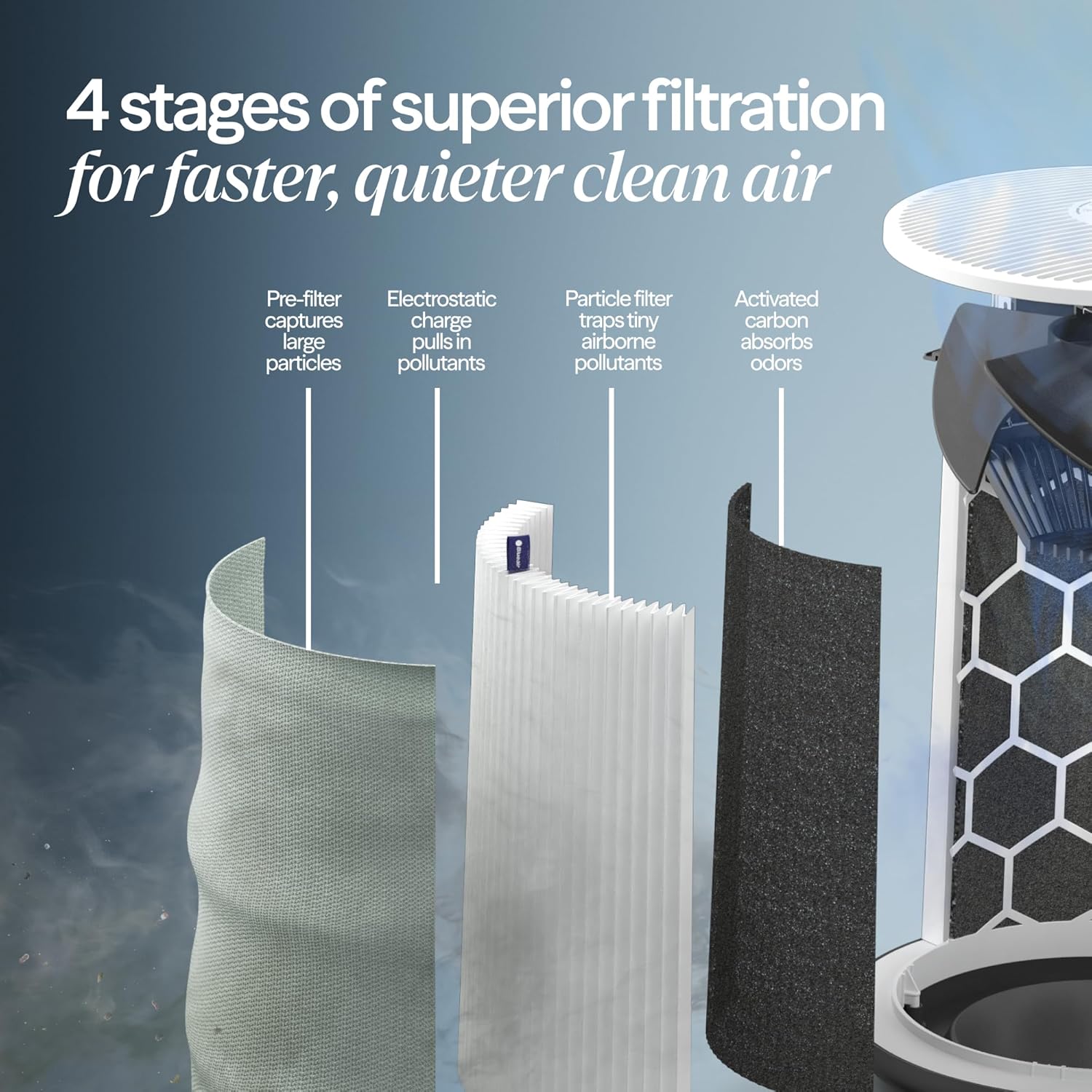
| Filtration | HEPASilent dual filtration (mechanical + electrostatic) — 99.97% of particles down to 0.1 microns, plus an activated carbon layer for odors & VOCs |
| CADR | 250 (smoke, dust, pollen) |
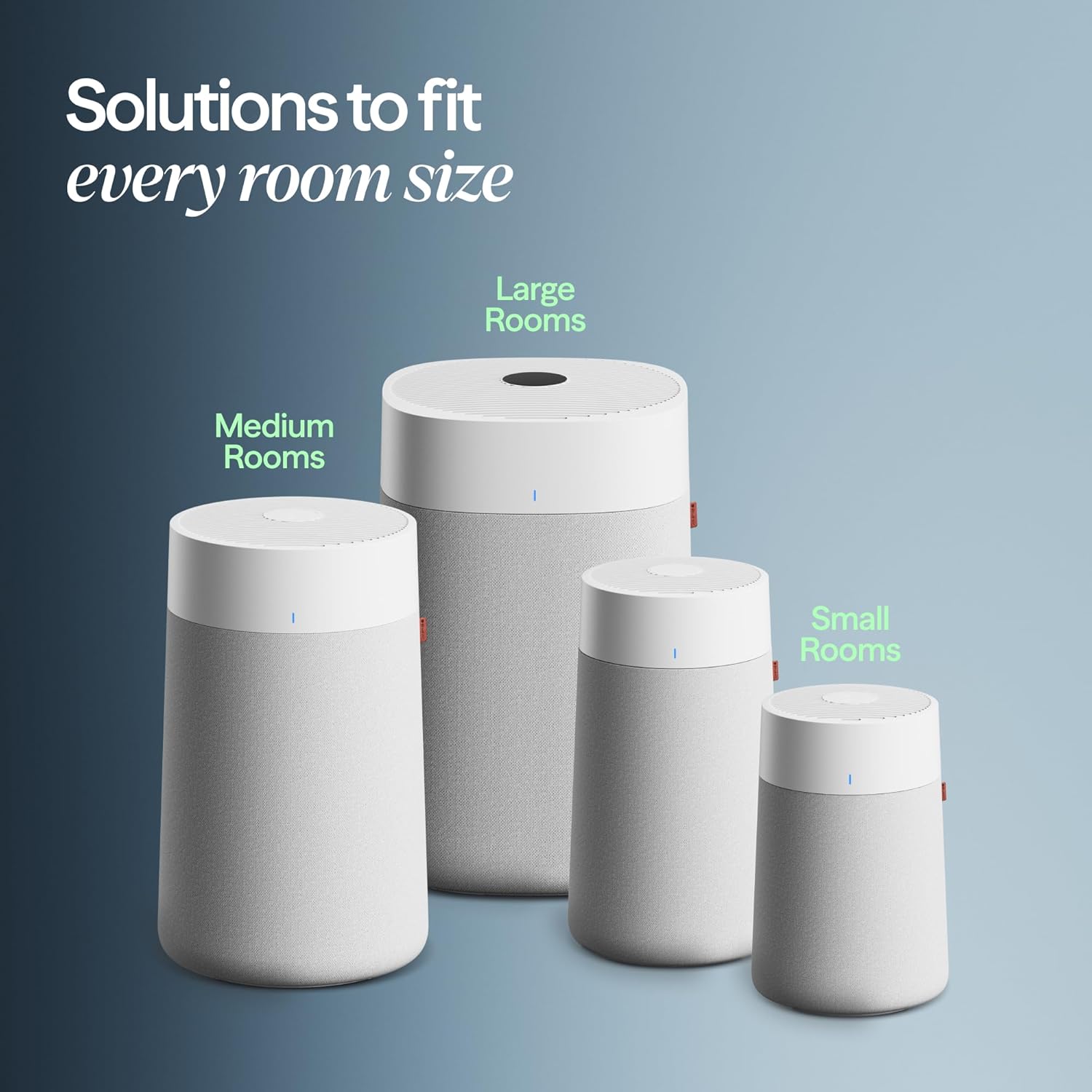
| Coverage | 387–929 sq ft depending on how many times you want the air turned over (≈387 sq ft at its most aggressive; roughly 3 air changes/hour in our ~600 sq ft basement) |
| Noise | ~23 dB on Night mode up to ~50 dB on high; QuietMark certified |
| Fan speeds | 4 total (Night + speeds 1/2/3) plus Auto mode |
| Smart features | Wi-Fi app, Auto mode, 5-color air-quality light, scheduling, child lock, Alexa voice control, Welcome Home, RealTrack filter tracking |
| Filter | Genuine F3MAX (particle + carbon), ~$50–70, lasts ~6–9 months with automatic tracking and a reminder |
| Safety | CARB certified (essentially zero ozone), AHAM Verifide for performance |
Pros and Cons After a Month
What I like:
- It’s genuinely quiet. On Night mode it’s around 23 dB — quieter than a whisper. I did the old receipt test and it moves a real amount of air while staying nearly silent.
- The app is excellent — which, if you’ve owned smart gadgets, you know is rare. I can manage the whole unit from my phone, see the filter life as a percentage, and it even shows air-quality readings in real time.
- Strong, credible filtration. HEPASilent dual filtration at 99.97% down to 0.1 microns, with a carbon layer that also handles odors.
- No ozone. It’s CARB certified, so it’s not pumping ozone into the room — a big deal if it’s going near a baby (see the nursery section).
- Set-and-forget Auto mode. I watched the air-quality light drop from green to blue and the fan quiet itself down as the air cleaned up. It reacts to the room without me touching it.
- Dead-simple filter access. Twist the top off and you’re looking right at the filter. The unit tracks filter life for you and tells you when it’s time.
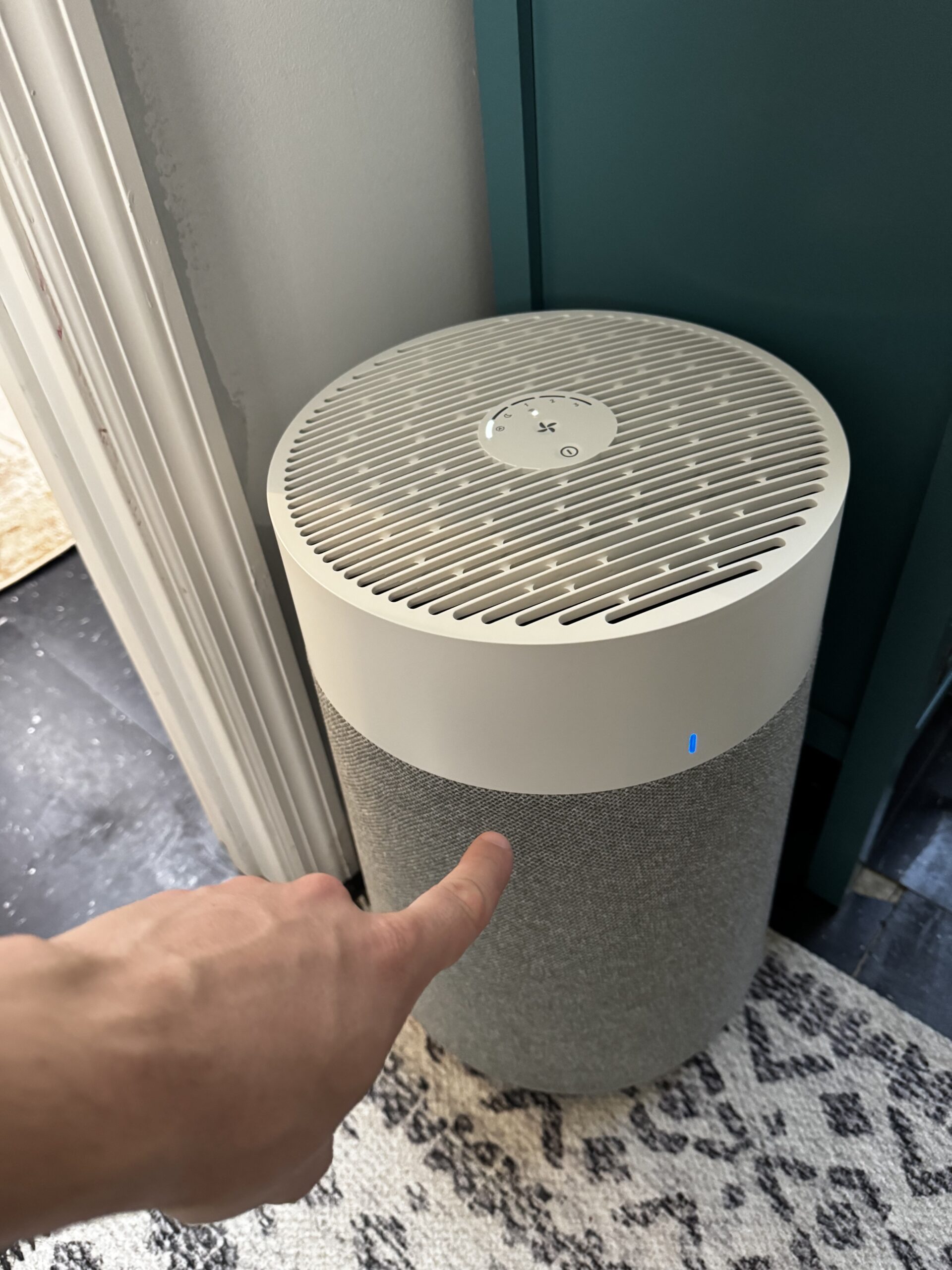
- Right-sized and good looking. Roughly knee height, tapered, tucks into a corner. It’s out in a living space all day, so that matters.
What to keep in mind:
- Genuine filters aren’t cheap. ~$50–70 every 6–9 months, so budget roughly $70–90 a year. Still cheaper than fussing with whole-home HVAC filtration, but it’s a real recurring cost.
- Room-size ceiling. It’s tuned for medium spaces. In our 600 sq ft basement it’s turning the air over about 3 times an hour — fine, but not aggressive. For a large open room, get the 211i Max instead.
- One tiny status light stays on even in Night mode. Minor, but if your room needs to be pitch black, a small piece of tape solves it.
- Wi-Fi setup is 2.4 GHz only. If you’re on a combined dual-band network name, you may need to point your phone at the 2.4 GHz band during pairing.
Is the Blueair 311i Max Good for a Nursery?
This is the whole reason I bought it — I’m doing this for my kid — so let me be straight about where it fits and where I’d temper expectations.
Where it’s a great nursery pick:
- Quiet enough for sleep. Night mode runs around 23 dB and fully dims the lights, so it won’t glow up a dark room or wake a light sleeper. It’s QuietMark certified for a reason.
- No ozone. Some purifiers (especially ionizers) can emit ozone, which is a respiratory irritant you really don’t want around an infant. This one is CARB certified with essentially none — that alone put it ahead of a few models I looked at.
- A nursery is small, so it works even harder. The coverage numbers are rated for medium rooms; drop it in a typical 120–200 sq ft nursery and it’s turning the air over far more often than it does in my basement.
- It catches the stuff that floats around a baby’s room — dust, pollen, pet dander, smoke, and airborne mold spores.
- Child lock and app monitoring. You can lock the buttons so a curious toddler can’t mess with settings, and check the air from your phone without opening the door.
Placement tips for a nursery: keep it at least a few inches off the wall so air can circulate, not right up against the crib, and route the cord well out of reach. And the honest caveat: an air purifier cleans airborne particles — it’s not a medical device and it’s no substitute for safe-sleep practices or your pediatrician’s advice. Think of it as one helpful layer, not a cure-all.
Will It Help With Mold in a Basement?
Partly — and this is worth understanding before you buy one expecting it to fix a damp basement. The 311i Max captures airborne mold spores, which is genuinely useful. What it does not do is remove moisture, and mold grows because of humidity. So in a damp basement like ours, the purifier is one half of the equation; pair it with a dehumidifier to actually control the conditions that let mold grow in the first place. Running both together is the real fix.
How Loud Is the Blueair 311i Max?
Very quiet where it counts. On the lower speeds and Night mode it’s around 23 dB — you have to get close to hear it. It only climbs toward ~50 dB when it ramps up to high (usually on Auto, when it’s detected a spike in particles). For a bedroom or nursery you’ll almost never notice it.
The Blueair App: Actually Worth Using
I usually ignore companion apps, but this one earns its spot. Here’s what it gives you:
- Filter life as a percentage (via Blueair’s RealTrack algorithm), so you’re not guessing or replacing early.
- Real-time air quality and a “Clean Air ETA” that estimates how many minutes until the room is clean.
- Scheduling — mine drops into a quieter mode in the evening automatically.
- Child lock, Alexa voice control, and Welcome Home (puts it on standby when you leave, wakes it as you get home).
Quick setup note: it needs a 2.4 GHz Wi-Fi network, Bluetooth on for the first pairing, and your phone within a few feet of the unit to connect.
What Do the Light Colors Mean on the Blueair 311i Max?
The front light is a 5-color air-quality readout based on the PM2.5 sensor:
- Blue — excellent
- Green — good
- Yellow — moderate
- Orange — polluted
- Red — very polluted
In the video you can watch mine go from green to blue as the air cleans up and the fan quiets down — that’s exactly how it’s meant to work. (Heads up: a steady red can also mean it’s time for a new filter, not just bad air.)
How Do You Change the Blueair 311i Max Filter?
It’s about a two-minute job:
- Turn the unit off and unplug it.
- Push the top cylinder down slightly while rotating it counterclockwise to unlock, then lift it off.
- Open the pre-filter panel and remove the washable pre-filter.
- Lift out the filter shelf ring, then grip the handles on the main filter and pull straight up.
- Drop in the new genuine F3MAX filter with the handles facing up, press the shelf ring back into place, and reassemble the top.
- Plug it back in and reset the filter indicator (next section).
Tip: give the inside a quick vacuum while it’s open, and wash the pre-filter on a gentle cycle now and then to extend the main filter’s life.
How Do You Reset the Filter Light on the Blueair 311i Max?
After you install a new filter, you have to reset the reminder manually or it’ll keep nagging you:
- With the unit on, press and hold the Fan Speed button for about 15 seconds — until all the interface LEDs light up (for the second time) and blink once.
- Release the button.
- If it worked, the red filter-replacement indicator blinks three times and disappears.
Bonus tips: to adjust brightness, press the Fan Speed and On/Standby buttons together and hold for three seconds. To do a factory reset, hold On/Standby for about 30 seconds.
Want to grab one? You can check the current price here:
Frequently Asked Questions
Is the Blueair 311i Max worth it?
For a nursery, bedroom, or medium room up to roughly 400–600 sq ft, yes. It’s quiet, the filtration is strong, the app is excellent, and it emits essentially no ozone. Just factor in ~$70–90/year for genuine replacement filters, and pick a bigger model if you’re treating a large open space.
Is the Blueair 311i Max good for a baby’s room?
It’s a strong nursery choice: Night mode is around 23 dB with fully dimmed lights, it’s CARB certified so it doesn’t produce ozone, and a small nursery lets it turn the air over frequently. Keep it away from the crib and out of reach, and remember it’s a complement to — not a replacement for — safe sleep and pediatric advice.
Does the Blueair 311i Max produce ozone?
No. It’s CARB certified for ozone safety with essentially zero emissions, which is one of the reasons it’s a sensible pick for a room with a baby in it.
How often do you change the Blueair 311i Max filter?
Every 6–9 months, depending on use and air quality. The RealTrack algorithm tracks actual filter life and alerts you in the app and with the light on the unit, so you’re not guessing.
How much are Blueair 311i Max replacement filters?
The genuine F3MAX filter runs about $50–70. Replacing it every 6–9 months works out to roughly $70–90 a year.
How do you reset the filter light on the Blueair 311i Max?
Press and hold the Fan Speed button for about 15 seconds until all the interface LEDs light up and blink once, then release. The red filter indicator will blink three times and turn off.
Is the Blueair 311i Max quiet enough for a bedroom?
Yes. On Night mode it’s about 23 dB and dims its lights, so it won’t disturb sleep. It only gets louder (up to ~50 dB) when it ramps up on high.
What size room does the Blueair 311i Max cover?
Blueair rates it for 387–929 sq ft depending on how aggressively you want the air cleaned. It’s at its best in small-to-medium rooms; for a large open space, step up to the 211i Max.
Does the Blueair 311i Max remove mold?
It captures airborne mold spores, but it doesn’t remove moisture — and humidity is what causes mold. In a damp basement, run it alongside a dehumidifier for the real fix.